
Faster Processing Times
Rethinking Returns Logistics
Process returns efficiently, make better use of space, and get products back into sellable condition faster. Returns are one of the biggest cost drivers in logistics today. Companies handling high return volumes know the challenge all too well: customers expect fast refunds and transparent processing, while warehouses face additional workload, space requirements, and process costs.Yet the real bottleneck is rarely the product inspection itself. Most of the effort occurs between individual process steps: items need to be located, transported, temporarily stored, handled multiple times, and manually routed to their next destination.This is exactly where advasolutions comes in.
About our solutionEfficient Space Utilization
Full inventory Transparency
.png)
The Reality of Manual Returns Processe
In many returns centers, volumes are growing faster than productivity. The result: rising costs, increasing space requirements, and a high dependency on workforce availability.
.png)
Typical challenges include:
The result: the returns warehouse gets bigger, but not necessarily more productive. Every additional manual step increases costs, processing times, and the risk of errors.
Unstructured Goods Receipt
Returns arrive without a structured flow and must first be identified.
Multiple Manual Handling Steps
Items are moved manually several times before they are finally assessed or put into storage.
Time-Consuming Search and Walking
Employees spend valuable time searching, walking, rearranging goods, and waiting.
Seasonal Volume Peaks
Seasonal peaks put pressure on staff, available space, and existing processes.
Lack of Process Transparency
The processing status of individual returns is not consistently transparent.
Long Buffer and Dwell Times
Goods remain in buffer areas for too long before they can be resold, repaired, recycled, or disposed of.
Increasing Space Requirements
Business growth quickly raises the question of whether additional warehouse space is required.
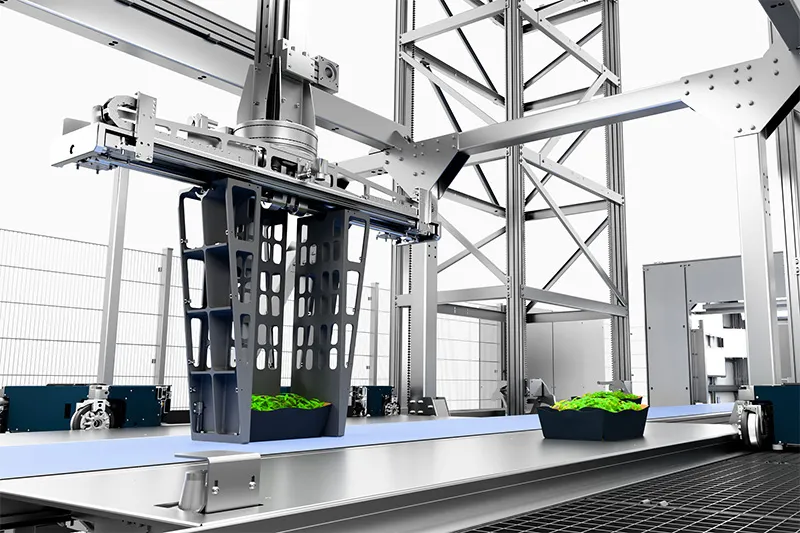
Imagine If the Goods Moved by Themselves
With advasolutions technology, returns logistics can be organized in a fundamentally different way. Instead of employees walking to the goods, the goods are automatically brought to the right workstation.
Each return is registered and identified upon arrival and then stored or routed to the next process step under system control. Transport distances, search times, and unnecessary intermediate movements are reduced.
Employees can focus on value-adding activities such as inspection, assessment, refurbishment, and approval.
How Automated Returns Logistics Works
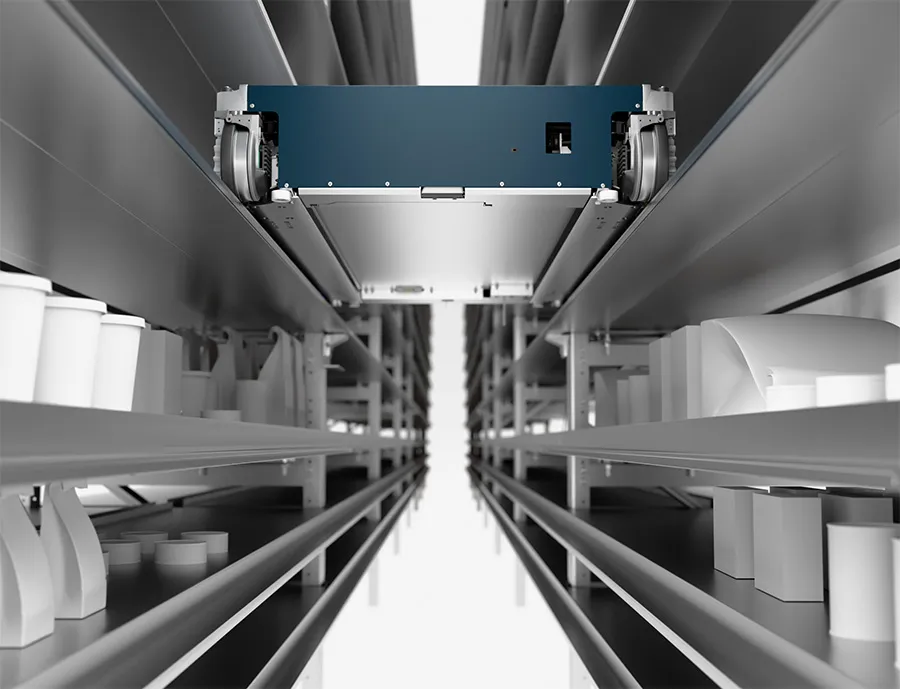
1. Digital Registration at Goods Receipt
Relevant information about each return is captured as soon as it arrives. This may include product information, handling unit data, weight, dimensions, barcode or QR code data, and images.This creates a traceable digital record for every return right from the start.
Relevant information about each return is captured as soon as it arrives. This may include product information, handling unit data, weight, dimensions, barcode or QR code data, and images.This creates a traceable digital record for every return right from the start.
2. Dynamic Storage Instead of Fixed Storage Locations
Goods are stored automatically. The system identifies suitable storage areas based on capacity, dimensions, weight, zone, status, and other project-specific criteria.Fixed product locations are not required, allowing the available warehouse space to be used much more flexibly.
Goods are stored automatically. The system identifies suitable storage areas based on capacity, dimensions, weight, zone, status, and other project-specific criteria.Fixed product locations are not required, allowing the available warehouse space to be used much more flexibly.
3. Automatic Delivery to the Right WorkstationScans in incoming goods
If an item requires inspection, reconditioning, quality assurance, or further processing, it is automatically delivered to the appropriate workstation.Workstations can be configured with different capabilities, ensuring that tasks are only routed to locations where they can be handled correctly.
If an item requires inspection, reconditioning, quality assurance, or further processing, it is automatically delivered to the appropriate workstation.Workstations can be configured with different capabilities, ensuring that tasks are only routed to locations where they can be handled correctly.
4. System-Guided Routing After Processing
Once an item has been inspected, the return can be routed according to the process decision. It may be returned to storage, sent for further processing, released for resale, repaired, recycled, or removed from inventory.
Every step remains digitally traceable.
Once an item has been inspected, the return can be routed according to the process decision. It may be returned to storage, sent for further processing, released for resale, repaired, recycled, or removed from inventory.
Every step remains digitally traceable.
Frequently Asked Questions

Is automation worthwhile when return volumes fluctuate?
Yes. In fact, fluctuating volumes are one of the key reasons to consider automation. The system reduces dependency on manual transportation and time-consuming search activities.Seasonal peaks can therefore be handled in a more structured way without having to scale staffing levels for every individual process step.

What happens as our business grows?
The solution is designed to be modular. Storage capacities, workstations, and technical components can be expanded according to project requirements.This allows the returns process to grow with your business without immediately requiring an entirely new logistics infrastructure.

Can different types of products be handled?
Yes. Returns can vary significantly in terms of size, condition, value, and required processing path.The system logic can handle different inventory types, handling units, product attributes, status information, and process requirements.

How do we maintain transparency throughout the returns process?
Every inventory item is linked to digital information such as product details, quantity, status, storage date, client or business unit, and optional additional attributes.This makes it possible to track where goods are located, what status they currently have, and which process step comes next.

Do we need additional warehouse space?
Not necessarily. Dynamic storage, automated storage location assignment, and higher storage density can help make more efficient use of existing space.The objective is to manage increasing return volumes more effectively before additional warehouse space becomes necessary.

What does automation mean for our employees
Employees are not removed from the process. Instead, they are relieved of repetitive, non-value-adding activities.Rather than spending time searching for or transporting goods, they can focus on tasks where human expertise truly matters: inspection, decision-making, reconditioning, and handling exceptions.
From Cost Center to Competitive Advantage
The key question is not: How do I store returns? The better question is: How quickly can I get suitable returned products back into sales or into the appropriate downstream process?
The shorter the processing time, the lower the capital tied up in inventory. The more transparent the status of each return, the better the process can be managed. And the fewer manual transportation steps required, the more stable the operation becomes — even during periods of growth and seasonal peaks.
With advasolutions, returns logistics becomes an automated, transparent, and scalable process — for companies that want to do more than simply manage returns. They want to manage them efficiently and profitably.
The shorter the processing time, the lower the capital tied up in inventory. The more transparent the status of each return, the better the process can be managed. And the fewer manual transportation steps required, the more stable the operation becomes — even during periods of growth and seasonal peaks.
With advasolutions, returns logistics becomes an automated, transparent, and scalable process — for companies that want to do more than simply manage returns. They want to manage them efficiently and profitably.
.png)
©2025 Advasolution. All rights reserved