
Solutions
Industries
Applications
Company
From 26.01.2026 | 3 min. Reading time
The logistics industry will start 2026 with challenges that cannot be solved by simply continuing as before. Difficulties such as economic uncertainty in times of volatile markets make long-term planning almost impossible, while at the same time forcing companies to react quickly. At the same time, rising customer expectations in terms of delivery speed, transparency, and reliability are pushing logistics companies to the limits of scalability. Growing product ranges, limited space, and increasingly complex processes and systems —the list of challenges in the logistics industry is long. And then there is the shortage of skilled workers.
Many managers are faced with the same question: How can the warehouse system remain efficient despite global risks when personnel, space, and time are becoming scarce?
The answer is short: automation – one of the biggest logistics trends in the coming year, which addresses precisely these difficulties. The explanation, however, probably requires a few more words. Automation is no longer a nice-to-have, but a strategic lever for greater process stability, transparency in the data jungle, and urgently needed scalability. It enables companies to tackle the central challenges of intralogistics.
The labor market is clearly feeling the effects of demographic change: according to the Competence Center for Securing Skilled Labor (KOFA), a significant proportion of vacancies in transport and logistics professions have been unfilled for some time. The reality in many warehouses is that order books are full, but teams are getting smaller and smaller. And yet companies still need to maintain stable processes that demand ever greater flexibility.
Overtime and the use of expensive temporary workers are short-term solutions, but definitely not long-term ones. And they are certainly not solutions that promise competitiveness. A lack of qualified personnel can lead to delivery delays and quality losses. An efficient alternative is therefore needed.
Automation provides strategic relief here by:
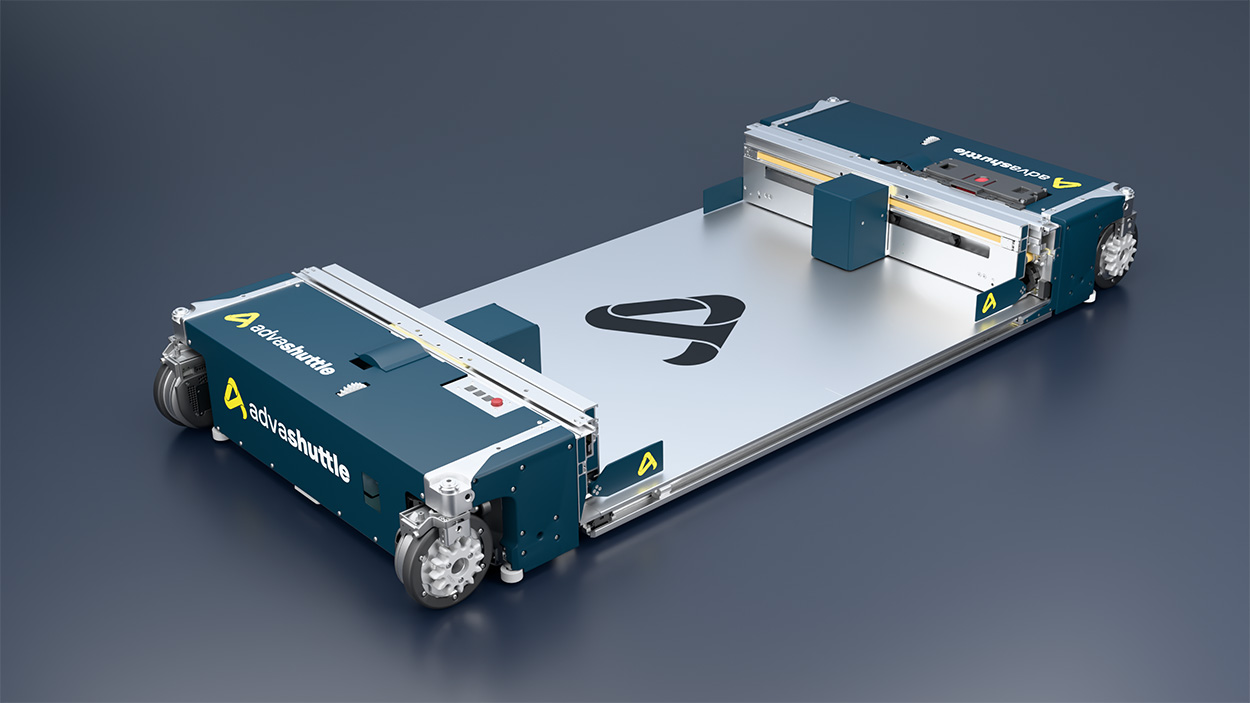
With the shuttle-based solution from advasolutions, combined with the customizable advaRack shelving system and flexible advaShelvs, you can automate central warehouse processes reliably, modularly, and scalably. The Warehouse Execution System (WES) serves as a central control center that coordinates all processes and ensures consistent data transparency, while the resulting digital twin is the virtual image of the warehouse. It makes processes visible in real time and detects deviations early on. This seamless integration of mechanics and IT is one of the most important logistics trends of our time. The results: minimized delivery delays, fewer errors, increased service and product quality, and thus reduced costs.
The result is a system that performs even when the labor market is tight.
In today's business world, the only constant is volatility. Markets are unpredictable: a crisis here, an unexpected e-commerce boom during COVID-19 there, followed by seasonal peaks such as Black Friday or the Christmas shopping season. For logistics companies, this means that it is almost impossible to plan for developments in order volumes and peak loads.
This uncertainty presents companies with a dilemma: if you invest in large storage capacities to cover peak demand, you risk high vacancy costs during quieter periods. If you stay small, sudden growth can lead to overload, delivery bottlenecks, and angry customers. Static logistics structures are a competitive disadvantage in this dynamic environment. Agile systems are needed that can breathe with the company.
Automation provides the necessary agility and scalability by:
The shuttles, flexible advaShelvs, and customizable advaRack system from advasolutions were developed precisely for these challenges in warehouse logistics: You start with the capacity you need today and simply expand the system as demand increases. The WES scales seamlessly with you. We offer you investment security through growth on demand, instead of risky upfront investments in rigid structures. With the automation solution from advasolutions, you have the opportunity to react quickly to volatile markets, seize new growth opportunities, and future-proof your operations with true scalability.
The supply chain is becoming increasingly complex. Over the years, many logistics companies have gradually added various technologies and tools—often useful, but rarely optimally coordinated. The result is a heterogeneous system landscape characterized by data silos, media breaks, and isolated solutions that work in parallel but not together.
The consequences of this lack of integration are serious: there is a lack of end-to-end transparency regarding inventories and utilization rates, the manual coordination effort between systems is high, and valuable automation potential remains untapped. With increasing demands on speed and error rates, this complexity is becoming a real obstacle to growth.
Automation provides the urgently needed integration and transparency by:
This is exactly where the solution from advasolutions comes in. We provide you with comprehensive automation, at the heart of which is our powerful, proprietary WES. It coordinates all warehouse processes in real time and integrates into your existing IT landscape via standardized, open interfaces. The resulting digital twin maps resources, movements, and inventories live, creating the end-to-end transparency you need for control. This turns technical complexity into a manageable and efficient material flow. You gain full control over your processes, thereby sustainably increasing the quality of your service.
Tomorrow's logistics will be more automated, data-driven, and modular. Processes will be increasingly networked and scalable, enabling companies to respond more quickly to fluctuations and maintain transparency over inventories and processes at all times. It requires more than just efficiency—it requires resilience. The key challenges of skilled labor shortages, volatile demand, and system complexity are no longer temporary phenomena, but the new normal.
These challenges are giving rise to one of the most important logistics trends for 2026: intelligent, data-driven, and modular automation. The solution from advasolutions offers exactly what you need – the necessary planning security paired with agility.
By relying on our scalable and integrated systems, you decouple your performance from external uncertainties: you ensure continuous availability despite staff shortages, respond flexibly to any boom or crisis, and remain in control at all times thanks to full data integration.
With advasolutions, you don't just automate your warehouse – you future-proof your business and make it ready for tomorrow.